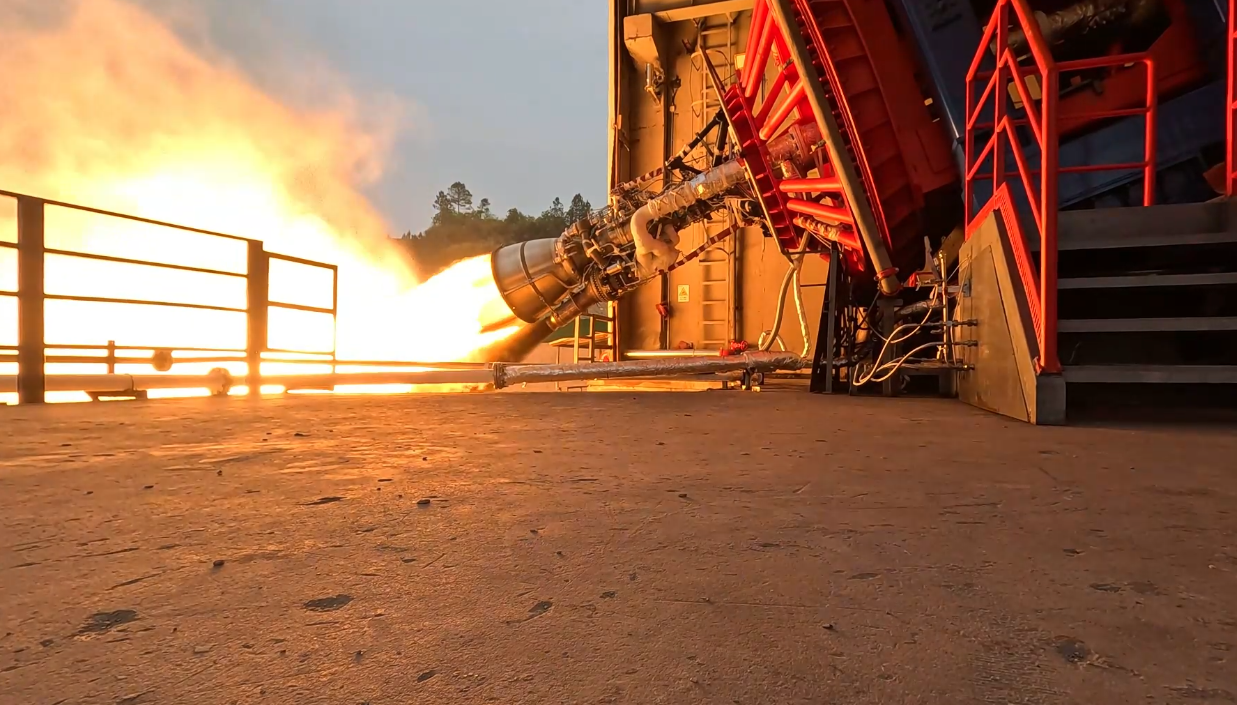
At 10:00 on September 1, 2026, at the Dongfeng Commercial Aerospace Innovation Test Zone. At the dedicated launch pad for the Zhishenxing series, the rocket lifted off and smoothly entered the predetermined orbit according to plan. Mission name — "Driving the Azure Dragon to Roam the Galaxy."
This was the first flight of Galactic Energy's PALLAS-1, and also the first time a Chinese private rocket achieved orbital insertion with a seven-engine parallel configuration. The rocket flew normally throughout, achieved the test objectives, and the mission was a complete success.
The rocket flew normally throughout the entire flight, achieved the test objectives, and the mission was a complete success. After satellite-rocket separation, the rocket completed, in accordance with the flight test outline, the prescribed actions before the second ignition, including propellant management during the high-altitude coast phase, tank pressurization, and engine precooling, verifying the correctness of the second-ignition sequence design; it then carried out passivation and deorbiting, successfully leaving orbit without leaving space debris and reducing the threat of collision with in-orbit spacecraft.
The successful maiden flight verified PALLAS--1's ability to "fly up." But since the project's inception, what PALLAS-1 has aimed at has never been only orbital insertion. According to the plan, PALLAS-1 will adopt a three-step strategy: baseline verification on the maiden flight has been completed; in subsequent flight missions, first-stage reentry control, grid fin operation, braking deceleration, and fixed-point recovery verification will be gradually carried out to achieve complete vertical landing and recovery of the first stage; finally, it will enter the stage of high-frequency reuse and large-scale commercial operations. Standing on independent technological innovation, with a full-series rocket lineup as the cornerstone. Taking airline-style space transportation as its mission, it forges ahead toward the boundless galaxy.